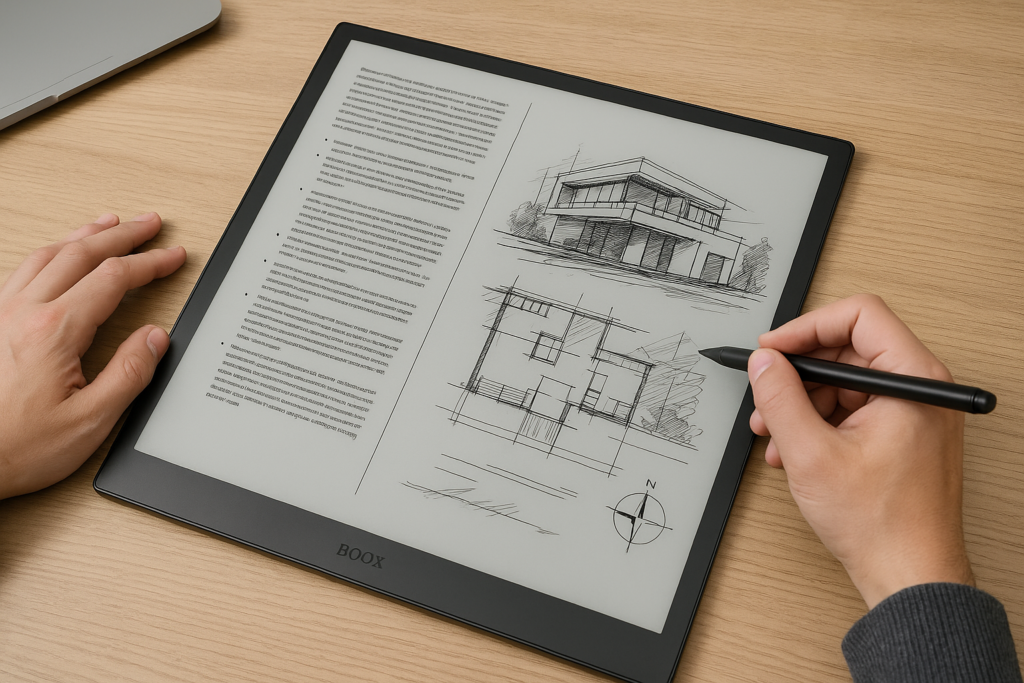
Large digital surfaces are gaining momentum across professional environments where precision, structure, and clarity shape the quality of thought. Architects, technical analysts, academic researchers, and visual creators know that ideas expand when there is enough space for them. Small screens once set the boundaries for mobile productivity, but the shift toward large-format E-Ink devices is rewriting those limits. Among the devices leading this shift, modern large-screen E-Ink workstations have become some of the most compelling examples of how a generous digital canvas can change both the pace and quality of work.
A broad screen brings a type of comfort that is subtle yet powerful. Text breathes, diagrams settle into readable proportions, and long-form content is easier to navigate. When professionals talk about efficient reading or structured thinking, they often refer to the balance between focus and visibility. A large-format E-Ink device offers that balance naturally. The BOOX Note MAX sits at the center of this movement, not because it is trendy, but because it solves a long-standing friction: how to combine paper-like clarity with digital depth.
Writers who annotate complex reports, analysts who work with multi-page briefings, and architects who draft initial sketches often reach a point where small screens turn into an obstacle. Fatigue increases, scrolling becomes constant, and the sense of a complete page is lost. A bigger canvas restores that sense of control. In the first half of long documents, especially those filled with tables or multi-column layouts, the BOOX Note MAX allows the page to appear as it was intended. No compression. No awkward scaling. Just structure, in its natural size.
Large-format digital workspaces also elevate the way creative minds function. Artists who rely on charcoal-like strokes, clean marker lines, or subtle shading often find that smaller displays compress their gestures. The wider the working surface, the more natural the motion becomes. When hand movement matches the scale of intention, the output feels more authentic. That is why so many visual professionals are shifting their attention toward spacious E-Ink surfaces. The shift is not about bigger for the sake of bigger; it is about matching the physical rhythm of the hand with the cognitive rhythm of the mind.
Deep content management is another reason large-format E-Ink is gaining traction. Professionals are no longer satisfied with devices that act as passive readers. They want structured folders, layered notes, accurate handwriting recognition, and flexible export options. They need a device that responds to multi-disciplinary workflows, not just single-task reading. The modern document environment is richer, more interconnected, and more demanding. Large-format devices answer that demand by making it easier to keep research materials, annotations, sketches, and reference documents in one place.
A notable aspect of this trend is that E-Ink technology has matured far beyond its early reputation as a tool strictly for reading books. The crisp rendering, low power consumption, and eye-friendly experience now intersect with advanced processing and flexible software. This gives the large-format category a new dimension: it becomes a workstation that does not exhaust the eyes, even after hours of focused activity. When architects review blueprints or UX designers iterate on wireframes, that comfort becomes more than a bonus; it becomes a strategic advantage.
Midway through the conversation about digital tools, the source of innovation matters as much as the tools themselves. Platforms like einktab.ca have helped professionals understand how to pair the right device with the right workflow, particularly when large-format E-Ink is becoming integral to modern productivity.
The rise of big-screen E-Ink is not only a matter of visual comfort. It has to do with depth of thinking. Long texts, layered materials, reference-heavy research, and creative drafts all benefit from a surface that supports extended concentration. When everything fits onto a page without constant adjustment, the mind settles into a clearer pattern of work. Screens that mimic the structure of printed materials provide a quieter and more deliberate kind of productivity. Professionals who spend their days moving between complex datasets, architectural notations, or editorial layouts can feel an immediate difference.
Architects often point to the pleasure of having enough space for both the sketch and the idea. Analysts appreciate the calm of reading a report at its intended size, without breaking paragraphs into fragments. Artists value the integrity of line flow and the ability to move the hand freely. These are different tasks, but all benefit from one shared element: space.
The shift toward large-format E-Ink devices suggests that digital tools are no longer competing with paper by copying its function; they are surpassing it by enabling workflows that paper cannot fully support. The union of clarity, scale, and intelligent document management has created a category that stands on its own.
The new standard is not defined by screen size alone. It is defined by the renewed experience of thinking with room to think. Tools like the BOOX Note MAX show that the future of digital work is not about reducing everything to a smaller scale. It is about giving ideas the space they deserve.