
You know the feeling, you’ve made the room feel calm and considered, then the radiator pulls the whole wall back into the past. A white column radiator is one of the simplest upgrades that fixes both the heat and the look, without turning your room into a “feature radiator” showroom.
Those crisp vertical columns and a bright white finish are doing more work than people realise. They tidy up sightlines, bounce light, and make the heating feel intentional rather than an afterthought.
I’ll show you how column depth, size and btus change the performance, and how to choose a model that suits your room and layout.
We’ll also cover pricing and what to check with the courier before delivery, including options you’ll see from Planet Radiators and other designer radiators suppliers.
Key Takeaways
- White column radiators (2 to 6 columns) commonly come in heights of 300 to 1,800 mm and widths of 162 to 1,864 mm, so you can fit awkward walls and still keep floor space clear.
- Most UK column radiators are steel with powder-coated finishes, and many ranges offer 5 to 10 year warranties, so you can treat them as a long-term fixture rather than a short-term style choice.
- Always match output using the same temperature rating: outputs are commonly published at ΔT50 (often shown as T50). If you run a heat pump or low flow temperatures, you must check the lower-temperature output too.
- For “cheap designer radiators”, the best value usually comes from getting the sizing right first. A lower-priced radiator that’s underpowered costs you more in comfort and running time.
What Are White Column Radiators (and what makes a white column radiator different)?
White column radiators are hydronic radiators built from repeated vertical “columns” or sections. Hot water circulates through the columns, and the radiator heats the room using a mix of convection (warm air movement) and radiant warmth from the surface.
In the UK, you’ll usually see sizes built around sections, which is why widths can start as narrow as 162 mm and extend to 1,864 mm (and beyond in some ranges). That section-based build makes them easier to fit to real rooms where a standard panel radiator looks like it’s either too small or too dominant.
Before you compare column radiators on output, check the temperature rating. UK-compliant outputs are commonly stated at ΔT50 (for example 75/65/20°C flow/return/room). If a listing only shouts a big BTU number with no rating, you can’t compare it fairly.
- Best for: living rooms, bedrooms, hallways, kitchens, and anywhere you want traditional styling with modern performance.
- What you control: height, width, column depth (2 to 6 columns), and orientation (horizontal or vertical).
- What usually comes in the box: wall brackets, a bleed valve, and a blanking plug (valves are often sold separately).
Features of White Column Radiators
A good white column radiator gives you a clean architectural shape, then quietly does the practical work: steady heat, straightforward controls, and finishes that don’t turn yellow or chip easily in normal use.
When you’re comparing traditional column radiators to newer designer radiators, these are the features that make the difference day-to-day.
- Output you can match: clear watts and btus, ideally at ΔT50, and also at ΔT30 if you run lower system temperatures.
- Finish that stays bright: powder-coated or multi-layer painted finishes designed for heating surfaces.
- Flexible mounting: wall brackets are standard, and some ranges offer optional feet if you prefer the period look or want extra stability.
- Control-ready: works with thermostatic radiator valves (TRVs) and smart controls for room-by-room comfort.
Classic clean lines and timeless design
The biggest visual win is simple: columns read as intentional “lines”, not a bulky box. That’s why white column radiators sit comfortably in both modern minimal rooms and older properties with cornices, picture rails, and original fireplaces.
Placement matters as much as the radiator. You’ll still get excellent results under a window or on an outside wall, because you’re heating where the cold air tends to drop and circulate.
- Leave clear space under the radiator (a 100 mm gap is a useful rule of thumb) so warm air can move freely.
- Avoid blocking it with deep shelves, tight furniture, or heavy full-length curtains that trap warm air.
- If the room is well insulated and double glazed, you can place the radiator where it suits the layout, as long as airflow stays open.
A clean wall elevation is rarely about one “feature”. It’s about removing visual interruptions, and the right radiator does exactly that.
Gloss white finish for a modern touch
Most white column radiators use a standard bright white shade, often listed as RAL 9016. That matters because it tends to sit well against modern whites on woodwork and ceilings, and it looks crisp under cooler LED lighting.
The finish is usually powder coating or a sprayed system designed for hot surfaces. For maintenance, stick to soft cloths and mild soapy water, and avoid abrasive pads that can dull the sheen or leave fine scratches that catch dirt.
- Quick clean: dust between columns, then wipe the front faces.
- Deeper clean: vacuum behind the radiator, then wipe with a barely damp cloth and dry it off.
- If you notice discolouring: check for cooking grease (kitchens) or nicotine residue (older homes) before you assume the paint has failed.
Multiple column depths and orientations
Column depth is the practical knob you can turn without changing the style. A 2-column radiator is slimmer and lighter visually, while 4 to 6 columns add depth, water volume, and more output potential.
Many models are made in sections, so you can often fine-tune width in small steps. For example, in some 1,800 mm tall vertical ranges, each extra section adds roughly 40 to 50 mm in width, which is handy when you’re working around sockets, door trims, or tight returns.

| Choice | When it tends to work best | What to watch |
| 2 to 3 columns | Smaller rooms, tighter walkways, “quiet” walls where you want the radiator to blend in | Check the output carefully if ceilings are high or insulation is poor |
| 4 to 6 columns | Larger rooms, colder outside walls, lower-temperature heating where you need more surface area | Depth can affect furniture placement and curtain lines |
| Horizontal | Under windows, wide walls, replacing a standard panel radiator | Keep airflow clear if you have long curtains |
| Vertical | Narrow walls, tight layouts, modern elevations where height looks deliberate | Confirm pipe positions and valve access before ordering |
Benefits of White Column Radiators for Interior Design
White column radiators are one of those rare upgrades that makes a room look more “finished” while improving comfort. The shape is disciplined, the colour is forgiving, and the sizes are flexible enough to fit real UK rooms.
If you’re comparing options and want a simple place to track pricing decisions and delivery details, keep your shortlist with notes on model size, ΔT rating, and delivery and pricing notes so you can make a clean comparison before you order.
Done well, this is how you get that clean, elegant look without sacrificing heat output or making the heating feel like an afterthought.
Creates a minimalist and elegant aesthetic
Minimalist rooms fail when one object adds visual “noise”. A white column radiator avoids that because the columns repeat in a calm pattern and the bright finish keeps the wall feeling open.
Think in elevations, not products. If you keep skirting, sockets, frames, and the radiator in a consistent palette, the whole wall reads as a single surface, which is exactly what makes a room feel more considered.
- Choose a slimmer 2-column model for the most discreet look.
- Use a vertical radiator on a narrow wall to keep furniture layouts flexible.
- If you need help comparing like-for-like, use a single reference note such as your spec and price tracker, then check outputs at the same ΔT rating.
Complements both traditional and contemporary décor
Traditional column radiators look at home beside period details, but the white finish stops the space feeling heavy. In newer homes, the same radiator reads as clean and architectural, especially with straight pipework and simple valves.
If you’re mixing old and new, keep the radiator classic and let the room do the styling. That approach is often cheaper than chasing a trend-led radiator shape that dates quickly.
- Period rooms: pair with simple white woodwork and warm metals (brass, bronze) in taps and handles.
- Modern rooms: pair with matte black hardware and sharper lines in lighting and joinery.
- Bathrooms: a white towel radiator can keep the same palette while adding function.
Enhances the perception of space and cleanliness
White reflects light, so it naturally makes rooms feel brighter. That’s especially useful in UK homes where winter light levels are low and north-facing rooms can feel flat.
You also get a practical “cleanliness” benefit: dust shows up sooner on white, which sounds negative, but it pushes you towards quick wipes that keep the radiator performing well and looking fresh.
Interior design tip that saves heat: don’t trap warmth behind furniture or full-length curtains. Even a great radiator underperforms if you block airflow.
Choosing the Right White Column Radiator
The right choice comes down to three checks: the room’s heat requirement, the radiator’s output at the right temperature rating, and a size that suits your walls and furniture.
Get those right and you’ll end up with a radiator that looks intentional, heats evenly, and doesn’t force you into awkward layout compromises.
Consider size and heat output
Start with the room, not the radiator. Measure the length, width, and height, then run a BTU calculation that matches your system temperature assumptions (ΔT50 for many boiler setups, lower for heat pumps).
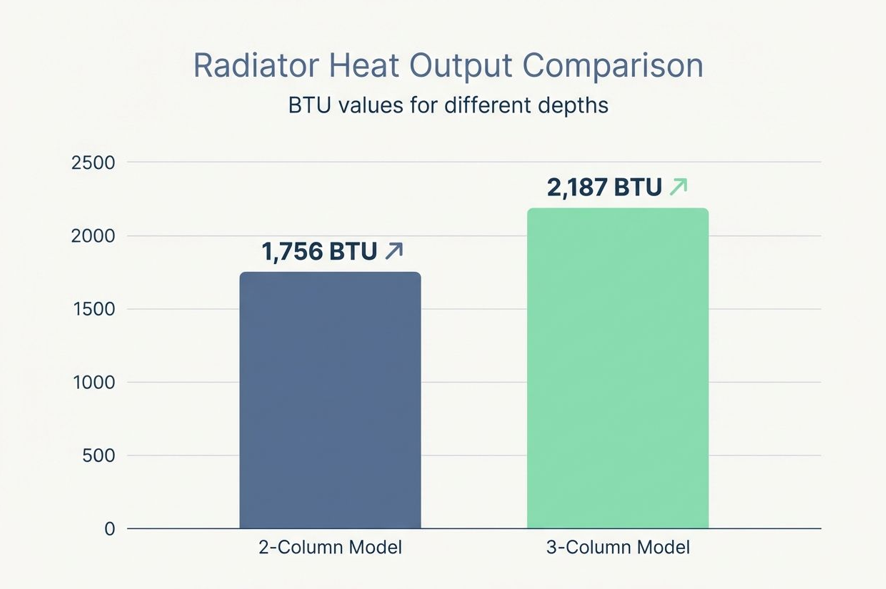
As a reference point for ΔT50 outputs, a 500 mm high by 605 mm wide 2-column radiator is often listed around 1,756 BTU, while a similar 3-column version can be listed around 2,187 BTU. Treat those numbers as a guide, then size from your own heat-loss calculation.
If you’re running lower flow temperatures, pay close attention to the lower-temperature output figures. Zehnder’s correction-factor guidance shows how sharply output drops as ΔT reduces, so you often need a larger radiator than you’d pick for a traditional boiler.
| What you’re checking | What “good” looks like | Why it matters |
| Output rating | Clearly shown at ΔT50, and ideally also ΔT30 | Keeps comparisons fair, and avoids under-sizing on low-temperature systems |
| Width and height | Fits the wall without clashing with curtains, doors, or furniture | Airflow and comfort suffer if you have to block the radiator |
| Valve plan | Valves and pipework line up with your layout | Neat pipework keeps the “clean interior look” promise |
Horizontal vs vertical designs
Horizontal radiators are the simplest replacement for a standard panel radiator, especially under a window. Vertical radiators work brilliantly on narrow walls where a horizontal model would be too short to deliver the heat you need.
- Go horizontal if you want wide, even warmth under glazing and you have the wall length.
- Go vertical if floor space is tight, the wall is narrow, or you want the radiator to read as part of the wall composition.
- Plan clearances so you can bleed the radiator and adjust the valve without fighting furniture.
Material and durability
Most modern column radiators are mild steel, then finished with powder coating for durability. Many reputable UK ranges are tested to EN 442, which standardises heat output testing and makes the figures more trustworthy when you compare models.
On the system side, modern UK guidance pushes for good controls, including room-by-room control using TRVs or equivalent. Worcester Bosch highlighted this shift with mandatory individual room temperature controls tied to wider building-efficiency rules, and it’s a key reason a well-sized radiator feels better than an oversized one with crude controls.
- Check the warranty length and keep the paperwork, especially if the radiator is part of a renovation project.
- Ask about delivery handling for heavy models. Many couriers deliver kerbside or to the doorstep only, so plan help for lifting and moving it safely.
- Protect the finish during install by leaving protective film on until the final tidy-up, then wipe it down before first use.
Conclusion
A white column radiator gives you clean lines, a bright finish, and a shape that suits both period details and modern rooms.
Choose the size from your room’s heat requirement, then confirm the output rating so your btus comparison stays fair.
Once you’ve shortlisted options from Planet Radiators and other designer radiators suppliers, double-check pricing and the courier delivery approach so installation day runs smoothly.
The result is a room that feels warmer, calmer, and more intentional.
FAQs
- What makes white column radiators create a clean, elegant interior look?
Their vertical columns and white finish keep lines simple and neat. They reflect light and add rhythm to a wall, so rooms feel more ordered and calm.
- Can white column radiators work in a small room?
Yes, a slim white column radiator, such as a steel column radiator, reads as less bulky and helps walls look taller.
- Are cast-iron column radiators outdated?
No, that is a myth. Cast-iron column radiators can look modern when painted white and they store heat for steady warmth. Use cast-iron column radiators in period homes, and pick steel column radiators if you need faster heat response.
- How should I place and style white column radiators to keep a clean, elegant interior look?
Sit them under windows to mask sill lines and match the finish to skirting or trim. Keep panels dust-free and choose simple grilles or covers to preserve the tidy interior design.