
Marketers often rely on fresh ideas, but strong campaigns begin with a precise understanding of information already in hand. Real performance comes from knowing which audiences respond, which channels deliver value, and where effort creates measurable impact.
By following structured data discovery steps, teams can identify reliable sources, organise information, and analyse patterns that define campaign outcomes.
This method establishes a solid foundation for informed decisions on budget, audience, and timing, transforming marketing activity into a process driven by clarity and evidence.
Seeing Marketing Through the Lens of Data
Marketing decisions depend on evidence that can be verified. Every action, from keyword choice to ad timing, produces numbers that describe what has happened. When teams begin to treat these numbers as a record rather than a reference, campaigns become easier to interpret.
Working with data starts from simple observations. A click-through rate that rises after a content change, or a sudden drop in engagement after a platform update — both hold information about behaviour. The task is not to collect every figure but to read the ones that indicate movement.
In most companies, even a single dashboard holds clues about audience rhythm, message fatigue, and budget timing. The challenge is recognising which of those clues actually point to performance.
Setting Up the Groundwork for Discovery
Data discovery is a sequence, not a single act. Before any analysis begins, marketers need to know what sources exist, how reliable they are, and who maintains them. Without that structure, later insights lose meaning.

The basic data discovery steps look like this:
- Locate the data. Map every system where campaign information is stored: ad platforms, CRM tools, analytics dashboards, sales reports.
- Assess quality. Check for duplication, inconsistent naming, and missing timeframes.
- Prepare structure. Clean files, align metrics, and record definitions for each data point.
- Store accessibility. Centralise the data in a space where both marketing and analytics teams can review it.
- Review regularly. Schedule updates so every dataset reflects the current campaign cycle.
When this foundation exists, the team can ask sharper, more insightful questions. Which audience segments grow fastest? Which messages lose relevance? Data without order answers nothing. Data with order builds a language that connects departments and guides creative work.
Reading Between the Metrics
Numbers do not explain themselves. Two campaigns can show identical conversion rates and still perform differently. The key is context — understanding why the figures look the way they do.
Marketers often begin by reviewing surface-level metrics, such as impressions, clicks, and conversions. But these metrics describe output, not process. To understand the process, attention needs to focus on supporting indicators, including session duration, scroll depth, engagement per visit, and cost per acquisition trend. These reveal behaviour before conversion.
Patterns often emerge across unrelated datasets. A rise in organic search may coincide with increased social engagement, indicating that content awareness is effective across multiple channels. Identifying these relationships depends on patient review, not automated scoring.
The strongest analysts in marketing teams learn to read metrics as a story: one data point defines the setting, the next reveals the action, and the following one confirms the outcome.
Turning Data into Direction
Insight is valuable only when applied. Once data is organised and interpreted, it must guide strategy. Teams should convert findings into actionable plans — budgets, messages, and timing.
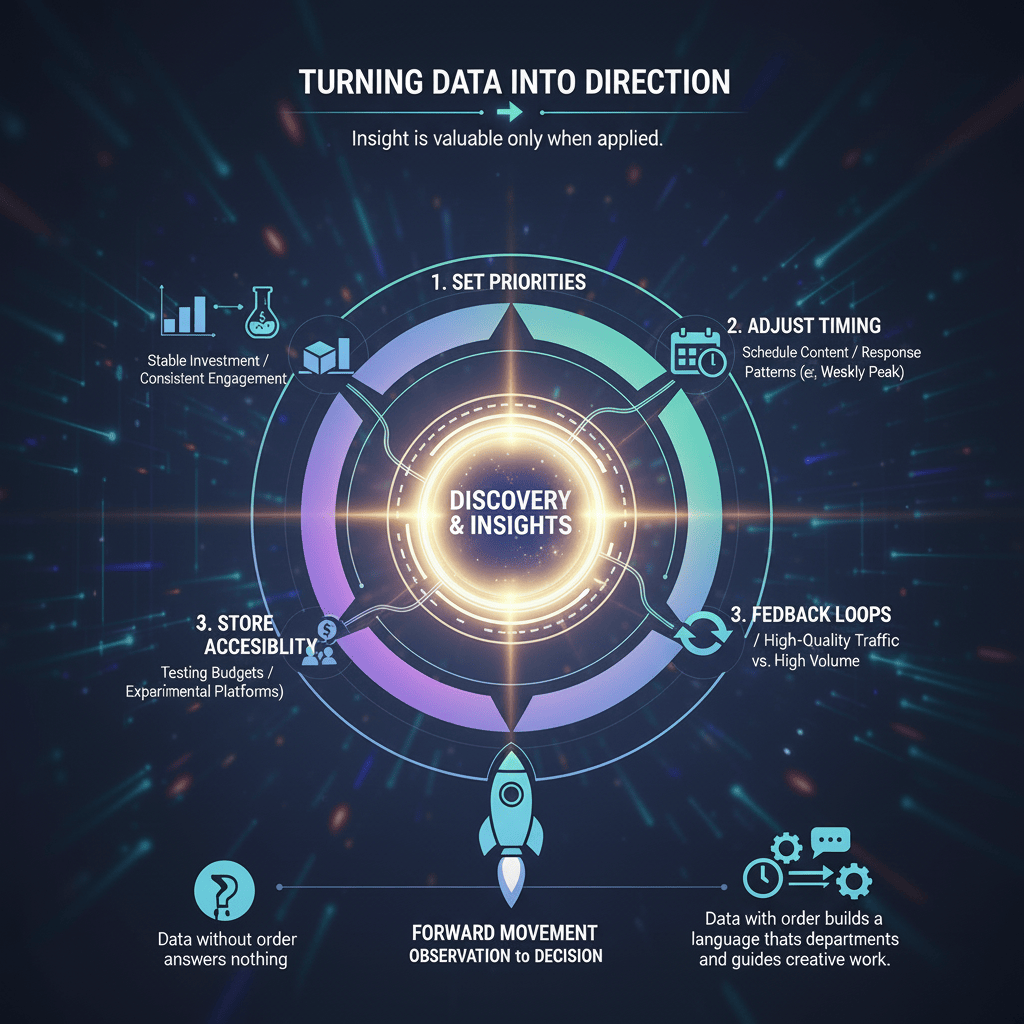
A structured workflow helps:
- Set priorities based on verified performance. Channels that bring consistent engagement deserve stable investment; experimental platforms require testing budgets.
- Adjust timing according to response patterns. If engagement peaks early in a week, schedule content accordingly.
- Refine messaging using feedback loops. Track which phrasing attracts the highest-quality traffic rather than the highest volume.
Each of these actions transforms static information into forward movement. The purpose of data discovery is not analysis for its own sake — it’s to shorten the distance between observation and decision.
Building a Culture of Evidence in Marketing Teams
A single analysis can significantly improve a single campaign. A culture of analysis can improve every campaign. For that to happen, data awareness must become a normal part of daily work.
Teams that succeed in this area usually follow several habits:
- Shared visibility. Everyone involved in planning should have access to the same reports. When information is open, discussions tend to remain factual.
- Regular review. Short post-campaign sessions where results are read together — not to assign blame, but to understand what really worked.
- Written continuity. Each campaign leaves a record of key insights, accessible to anyone starting a new project.
This approach creates continuity. New hires can see previous reasoning, experienced staff can challenge conclusions, and leadership can measure strategy against consistent evidence.
Over time, campaigns stop depending on opinion. Decisions become quieter, faster, and grounded in patterns that data has already confirmed.