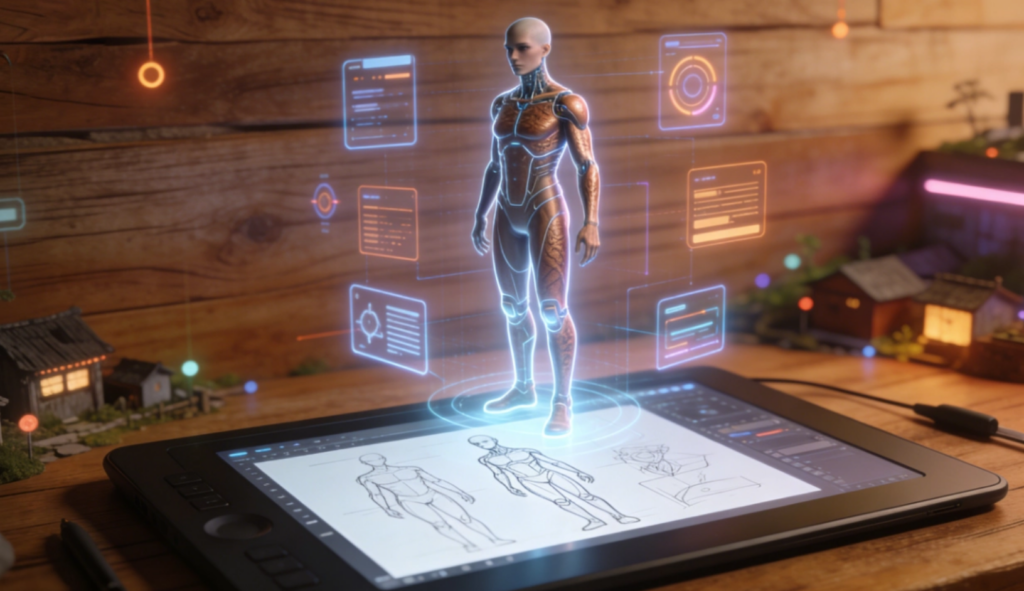
Redefining the Design Workflow: The Leap from 2D Concept to Production-Ready 3D
For decades, the path from a 2D sketch to a functional 3D asset was a linear, often grueling process. Designers would spend hours, if not days, manually plotting vertices and adjusting edge loops to translate a flat vision into a three-dimensional reality. However, as we move through 2026, the boundary between these dimensions is dissolving. The emergence of a seamless concept-to-3D transformation is allowing creators to bypass the technical heavy lifting and return to what matters most: pure imagination.
Breaking the Creative Bottleneck
The traditional struggle for digital artists has always been the “technical tax” on creativity. Every hour spent troubleshooting a mesh is an hour not spent refining the aesthetic. The latest advancements in neural generation are flipping this script. Instead of starting from a blank 3D workspace, designers are now beginning with their existing 2D assets, photos, character sketches, or AI-generated concepts, and using them as high-fidelity blueprints for instant reconstruction.
Neural4D is at the forefront of this shift. By processing visual data through specialized geometry engines, the platform produces a textured, rigged-ready asset in about 90 seconds. For a designer working on a deadline, this means the difference between exploring one idea a day and iterating on dozens.
Precision in Human Modeling
One of the most complex challenges in the digital space has always been the human form. Capturing the nuance of anatomy and the flow of organic surfaces requires a level of detail that many automated tools fail to reach. This is where the importance of evaluating the right 3D human generation methods becomes critical for a professional portfolio.
A key differentiator for Neural4D is its commitment to quad-dominant topology. In the world of design, “triangulated” meshes are often considered “dead” files—hard to edit and impossible to animate smoothly. By producing clean, four-sided polygon structures, the engine ensures that the generated human models are ready for the “Designing Corner” of any professional project, whether it’s for an AR filter, a social media avatar, or a digital fashion showcase.
Automating the Infinite Asset Library
For the modern “Tech Colony,” the goal is often scale. Whether you are building a virtual environment or an interactive app, you need more than just one hero asset; you need a world of objects.
The implementation of batch inference allows designers to upload entire folders of concept art and receive a library of 3D assets in return. This automation doesn’t replace the designer; it elevates them to the role of a creative director. By automating the reconstruction of secondary assets, creators can focus their energy on the “Future Frontiers” of their project—the lighting, the interactivity, and the story.
Conclusion: The New Dimension of Design
The design revolution of 2026 is defined by the removal of friction. As tools like Neural4D continue to refine the speed and structural integrity of 3D outputs, the “Designing Corner” will become more accessible and more powerful than ever before. We are entering an era where if you can see it in 2D, you can hold it in 3D. The transformation is complete, and the only limit left is the depth of your concept.