
Connected vehicles rely on software platforms, cloud infrastructure, and IoT connectivity to operate effectively. The automotive industry continues moving toward software-defined vehicles, where remote diagnostics, OTA updates, and fleet-level data influence daily operations.
Technology providers support these capabilities by building telematics systems and cloud environments that process and manage vehicle data. Their engineering approach determines how reliably connected vehicle platforms function at scale.
Core Components of Connected Vehicle Technology
Connected vehicle systems operate through multiple integrated technology layers. Vehicle sensors generate telemetry, which is transmitted through secure communication channels and processed in cloud infrastructure. This data enables remote diagnostics, software updates, and operational monitoring. Technology providers design and integrate these systems into connected vehicle platforms that support real-world deployment across fleets and mobility services.
Connected vehicle platforms typically include several core infrastructure elements:
- Cloud platforms supporting real-time vehicle data ingestion and processing;
- Telematics systems collecting and transmitting vehicle telemetry and diagnostics;
- OTA update infrastructure enabling remote software deployment and system maintenance;
- Data analytics platforms supporting predictive maintenance and performance optimization;
- Integration layers connecting vehicles with enterprise systems and mobile applications.
These components form the foundation of connected mobility systems. Providers differ in how effectively they integrate cloud, vehicle, and enterprise layers into a unified platform capable of operating at production scale.
1. Avenga

Avenga operates as a full-stack connected vehicle engineering provider. Their approach covers cloud platforms capable of processing large volumes of vehicle telemetry data, telematics infrastructure, and OTA systems supporting reliable remote software deployment. Predictive maintenance platforms and mobile-backend integration complete their engineering scope. Avenga Advanced Connected Vehicle Solutions span the entire value chain, from embedded systems to enterprise cloud layers.
Their engineering teams build and integrate across the technology stack rather than delivering isolated components. Key connected vehicle capabilities provided by Avenga include:
- Cloud-based vehicle data platforms for real-time monitoring and analytics;
- OTA update infrastructure for remote software deployment and system maintenance;
- Telematics systems supporting fleet visibility and operational efficiency;
- Predictive maintenance platforms using vehicle telemetry and cloud analytics;
- Mobile and backend integration enabling remote vehicle access and control.
Avenga functions as an engineering partner rather than a tool vendor. They provide transparent engineering processes and production-ready systems. Their full-cycle development capability eliminates the coordination overhead typical when working with multiple vendors.
2. Samsara
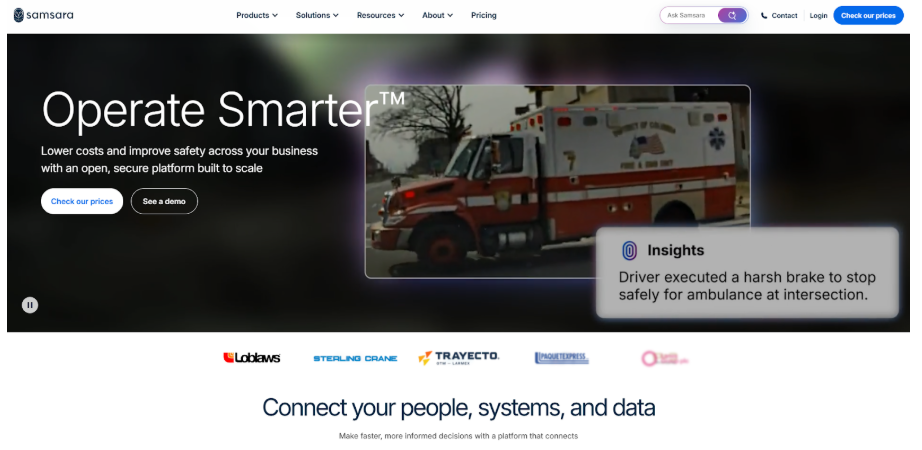
Samsara provides a connected operations platform focused on fleet connectivity and vehicle telematics. Their infrastructure supports real-time vehicle monitoring and operational visibility across transportation and logistics segments. The platform collects and structures telemetry data, enabling migration of physical operations into cloud-based systems.
Fleet operators use Samsara for vehicle tracking, diagnostics, and driver behavior analysis. Core connected mobility capabilities offered by Samsara include:
- Cloud-based fleet management and vehicle tracking platforms;
- Real-time telematics data collection and analytics;
- Vehicle diagnostics and operational monitoring tools;
- Integration with enterprise fleet management systems;
- IoT infrastructure supporting large-scale vehicle connectivity.
Samsara specializes in fleet-focused connected mobility. Their platform delivers structured dashboards supporting operational visibility and analytics for organizations managing vehicle fleets at scale.
3. Octo Telematics
Octo Telematics specializes in telematics infrastructure and vehicle data analytics. The company processes connected vehicle data across insurance, fleet, and mobility segments. Their platforms aggregate and analyze telemetry from large vehicle networks, supporting predictive analytics and performance monitoring.
Insurance telematics remains a core application area, with Octo systems assessing risk based on driver behavior and safety metrics. Key connected vehicle platform features provided by Octo include:
- Cloud-based vehicle data processing and analytics platforms;
- Telematics infrastructure supporting large connected vehicle networks;
- Predictive analytics for vehicle performance and safety monitoring;
- Integration tools for insurance, fleet, and mobility platforms;
- Scalable systems for real-time connected vehicle data management.
Octo demonstrates particular strength in vehicle data analytics at scale. Their infrastructure supports real-time processing across distributed vehicle networks.
4. Bright Box
Bright Box develops connected car platforms and OEM integration solutions. Their systems enable remote vehicle access and control through mobile applications integrated with cloud infrastructure. OEMs deploy Bright Box platforms to deliver connected vehicle features under their own brands.
The company focuses on production-ready deployments rather than concept demonstrations. Connected vehicle capabilities offered by Bright Box include:
- Connected car platforms enabling remote vehicle access and control;
- Cloud infrastructure supporting real-time vehicle connectivity;
- Mobile applications integrated with connected vehicle systems;
- OTA update capabilities and remote diagnostics tools;
- OEM integration services for connected mobility platforms.
Bright Box delivers connected car platforms that OEMs can brand and deploy at scale. Their integration capabilities span vehicle systems, cloud infrastructure, and mobile applications.
How Connected Vehicle Technology Providers Enable Smart Mobility
Connected vehicle platforms provide the foundation for smart mobility, fleet intelligence, and software-defined vehicle operations. These systems enable real-time visibility, predictive maintenance, and remote service delivery. Technology partners determine whether connected mobility implementations achieve scale and reliability.
Connected vehicle platforms enable several core smart mobility functions:
- Real-time vehicle monitoring and operational visibility;
- Predictive maintenance using vehicle telemetry data;
- Remote diagnostics and OTA software updates;
- Fleet optimization and performance analytics;
- Integration with cloud and enterprise mobility platforms.
Technology partners bridge the gap between vehicle telematics and enterprise cloud systems. Their platforms determine how effectively organizations can deploy connected mobility services.
Key Factors When Evaluating Connected Vehicle Technology Providers
Connected vehicle platforms operate across cloud infrastructure, embedded vehicle systems, and enterprise software environments. The choice of provider affects system reliability, scalability, and long-term operational flexibility. Organizations must evaluate providers based on engineering capability, platform architecture, and integration readiness rather than surface-level features. Providers differ significantly in how their systems handle real-time data, software updates, and enterprise integration requirements.
Several technical and operational factors determine the effectiveness of a connected vehicle technology provider:
- Cloud architecture supporting scalable and secure vehicle data processing;
- Integration capability with vehicle ECUs, telematics hardware, and enterprise systems;
- OTA update infrastructure, ensuring reliable remote software deployment;
- Data analytics capabilities enabling predictive maintenance and operational insights;
- Security architecture protecting vehicle systems and transmitted telemetry data.
These factors determine whether connected vehicle platforms can operate reliably ata production scale. Providers with strong engineering depth and integration expertise enable long-term connected mobility deployments rather than limited pilot implementations.
Conclusion
Connected vehicle platforms support smart mobility, fleet intelligence, and software-defined vehicle operations through cloud infrastructure and real-time telematics. Providers differ substantially in engineering depth, cloud capabilities, and integration expertise. Some deliver fleet management dashboards. Others, including full-stack engineering providers, build scalable connected mobility infrastructure across cloud systems, embedded platforms, and vehicle communication layers.
For organizations building serious connected mobility systems, platform depth determines operational outcomes. Engineering partners like Avenga support connected vehicle architecture across cloud infrastructure, embedded systems, and vehicle communication layers. The choice of technology provider shapes whether connected mobility implementations achieve production readiness and long-term scalability.